——THE ESSENTIALS——

THE DAY THE EARTH STOOD STILL (Robert Wise)
Some consider the Golden Age of Science Fiction to be in the 30’s and 40’s, when the pulp sci-fi magazines like Amazing Stories were at their height. But it was in the 50’s, stirred by the anxieties of living in the Nuclear age that interest in science fiction really took off. Radio series like Dimension X went on the air, soon followed by X Minus One. And when Fox greenlighted this classic of a visitor from another world, sci-fi hit the mainstream. THE DAY THE EARTH STOOD STILL got a sizable budget and an A-list director. In other words, it was taken seriously.
The film’s effectiveness is due in no small part to Bernard Herrmann’s out-of-this-world musical score, among his very best. Klaatu Barada Nikto!

ON DANGEROUS GROUND (Nicholas Ray)
Nicholas Ray was the director for the outsider, the outcast, the alienated. Robert Ryan was the actor always suggesting a smoldering volcano inside, full of turmoil and ready to explode. For ON DANGEROUS GROUND, Ray understood the character of the troubled cop prone to violence, just as well as Ryan knew how to play him. The resultant mix is the kind of alchemy that is uniquely cinematic.
Bernard Herrmann’s music subtly reinforces both the tension and the tenderness in one of his most “invisible” scores.

A PLACE IN THE SUN (George Stevens)
The tragic, heartbreaking story of crime, class and conscience adapted from the Theodore Dreiser novel, “An American Tragedy”. Montgomery Clift and Elizabeth Taylor are thoroughly believable. In real life, they became the closest of friends, sharing joys and tragedies of their own in the years to come. George Stevens’ thoughtful, slow-paced direction makes this a classic.

STRANGERS ON A TRAIN (Alfred Hitchcock)
In many ways, you could call this the most Hitchcockian of all of Hitchcock’s films. Adapted from the Patricia Highsmith novel, it has murder and suspense, sardonic humor and a captivatingly off-kilter villain. It also has the classic Hitchcock trademarks of the wrongly accused man and subtle sexual undertones. Visual set pieces abound (the tennis match, the merry-go-round, etc). Quintessential.

A STREETCAR NAMED DESIRE (Elia Kazan)
The one, the only, the legendary. Few other filmed plays reverberate as strongly today as they did when they were released. But STREETCAR has a life all its own. Credit to Kazan for being able to recreate his stage success from a few years before, helped by his original Broadway cast (Kim Hunter, Karl Malden, a kid named Brando) and Vivien Leigh from the London cast. Tennessee Williams helped adapt his play as they tip-toed around the censors to pull this one off.
—-JEFF’S PICKS—-
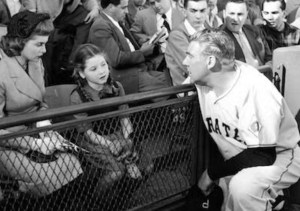
ANGELS IN THE OUTFIELD (Clarence Brown)
Still one of the best baseball movies ever. Great casting with Paul Douglas as the gruff, foul-mouthed skipper of the Pittsburgh Pirates, who are falling fast in the standings. They need some divine intervention, which is just what they get. For a fantasy, this movie stays grounded, funny and believable. Beautifully unsentimental. Surprising, considering that a cute 8-yr old orphan girl figures in the plot. The cooperation of the Pirates organization and the city itself doesn’t hurt. Location shooting at Forbes field and an authentic final game make this a must.

CRY DANGER (Robert Parrish)
A great example of early 50’s almost-indie (made for RKO-Radio Pictures) filmmaking. All location shooting in this film noirish crime thriller. Everybody cracks wise as Dick Powell plays an ex-con pardoned from prison, determined to put together the missing pieces about the caper that put him there. There’s a lot of tongue in cheek, but the action moves along nicely. Plenty of able support from Rhonda Fleming and character actors like William Conrad and Regis Toomey. Robert Parrish moved from editor to the director’s chair for this one. Veteran cinematographer Joseph Biroc was behind the camera.
But maybe the real star of CRY DANGER is the city of Los Angeles itself. Shots of Bunker Hill, Union Station and Chinatown in 1951 are priceless. Maybe that’s what helped the film get restored in 2011 by the UCLA Film and Television Archives.
 Essentials of Cinema